


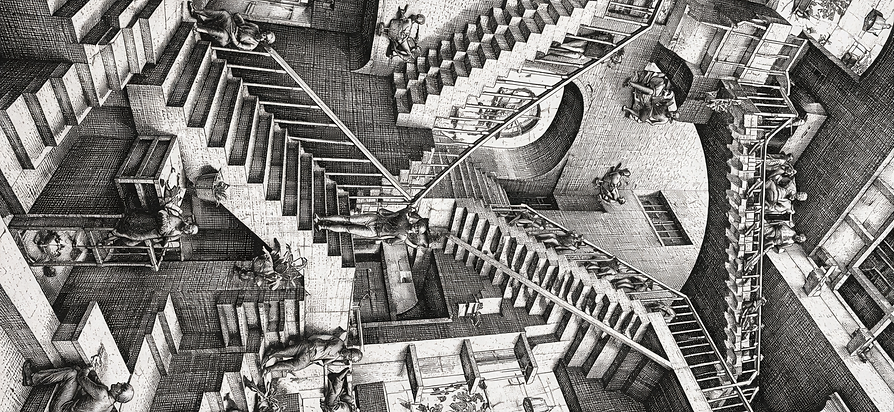
AI-generated image, freely inspired by MC Escher's "Relativity", 1953
Misinformation is now a systemic risk
The 2026 World Economic Forum's Global Risks Reports makes it very clear:
and here’s how Inezze turns “Proof You Can Trust” into a daily advantage
The 2026 risk landscape in one sentence
The World Economic Forum’s new Global Risks Report 2026 calls this moment “an age of competition,” with misinformation and disinformation elevated to a top short‑term global risk—tightly coupled with societal polarization and AI acceleration.
What the WEF is (really) telling boards, operators, and communicators
• Trust is deteriorating, fast. Half of the 1,300+ leaders surveyed expect a turbulent or stormy world over the next two years; pessimism rises further over a 10‑year view.
• Misinformation/disinformation sits at the center of the web of risks. It ranks #2 by severity in the two‑year horizon (and #4 over ten years), and is one of the most interconnected drivers of social fragmentation and crisis response failure.
• Audiences can’t tell real from fake. 58% of people globally worry about distinguishing truth from falsehood online (73% in some regions), while news avoidance is up and trust in news continues to slide—fertile ground for deception.
• AI raises both the stakes and the scale. “Adverse outcomes of AI” jumps from #30 (2‑year) to #5 (10‑year), reflecting rapid capability growth, deepfake proliferation, and automation of influence operations.
• What works, according to the WEF: accelerate public awareness and digital literacy, and deploy content authenticity and provenance standards (watermarking, origin metadata, content history) to rebuild information integrity.
Translation for the enterprise: if your organization produces or relies on visual evidence (photos, videos, screen recordings, live captures), proving authenticity is no longer a communications nicety—it’s a governance, legal, and revenue protection imperative.
How Inezze tackles misinformation and disinformation—by design
Inezze’s mission is simple: make authenticity the default in digital life. Its approach: shift from chasing fakes after the fact to proving the real at the moment of capture—with verifiable origin, edit history, and chain‑of‑custody attached to every asset. That’s provenance‑first governance, not reactive PR.
Here is the Inezze blueprint mapped to WEF guidance:
1. Capture‑time proof (not post‑hoc guesses): embed cryptographically bound provenance—who captured, when, where, and with what device—plus tamper‑evident edit trails. This meets the WEF’s call for authenticity standards that let stakeholders confirm what’s real and how it changed.
2. Chain‑of‑custody you can share: every asset carries forward its auditable history: ideal for regulators, journalists, platforms, courts, insurers, and customers who need to verify, not just believe.
3. Operationalize digital literacy: WEF says education is the #1 long‑term lever against polarization. Inezze makes “media literacy” actionable: recipients don’t have to be forensic analysts—they can check trust signals at a glance.
4. Build resilience before crises: by converting media into verifiable assets, comms, legal, risk, and security teams align on one source of truth - reducing dispute time and reputational damage when synthetic narratives surge.
Why provenance (not labels alone)? Independent reviews warn that human‑visible labels and generic watermarks are easy to strip or spoof; durable, machine‑readable provenance tied to a verifiable capture context is a stronger foundation—best used in combination with user education and detection.
Who benefits most from using Inezze regularly
1) Corporate Communications & Investor Relations
Problem: rumors, deepfaked “statements,” and fabricated clips can erase market value in minutes.
Inezze edge: Publish provenance‑backed media during announcements, product incidents, or M&A—so platforms, press, and analysts can verify and amplify quickly, not debate authenticity.
2) Legal, Compliance & Internal Audit
Problem: Evidence disputes stall investigations; chain‑of‑custody breaks weaken cases.
Inezze edge: Tamper‑evident trails and signed capture contexts reduce litigation risk and strengthen regulatory responses where authenticity is material.
3) Security, Trust & Safety, and Fraud Teams
Problem: Synthetic identities and manipulated proof fuel social‑engineering, brand impersonation, and stock‑price manipulation.
Inezze edge: A verifiable content perimeter—from supplier attestations to executive communications—raises the cost of deception and speeds takedown with platforms and partners.
4) Newsrooms, Documentation NGOs & Fact‑Checkers
Problem: Time‑critical decisions with uncertain sources, growing deepfake load.
Inezze edge: Source‑attached provenance shortens verification cycles, protecting reporters, witnesses, and archives—and preserving public trust in evidence.
5) Marketing & Brand
Problem: UGC programs and creator collabs face authenticity challenges; one fake “behind‑the‑scenes” can spark a crisis.
Inezze edge: Make proof a brand asset—verifiable behind‑the‑scenes, event coverage, and testimonials that withstand coordinated misinformation campaigns.
How Inezze is different
1. Provenance‑first, not post‑fact detection
Many solutions try to spot fakes after they spread. Inezze proves the real at the source, so distributors and algorithms can prefer verified assets—exactly the direction WEF encourages.
2. Enterprise governance, not just creator tooling
Inezze frames content as a governance object (policy, audit, access, legal hold), aligning comms, risk, and compliance. Competitors often stop at creator UX or generic watermark SDKs.
3. Shareable trust that travels
Proof remains portable across platforms, clouds, and archives—so verification doesn’t break when content moves. That’s critical in multiparty investigations, platform escalations, and media syndication.
4. Built for a standards‑led future
The WEF urges common content authenticity and provenance approaches; regulators are leaning the same way. Inezze is architected to interoperate with emerging provenance standards and industry trust signals.
A practical playbook for 2026: from “we believe” to “we can prove”
1) Provenance policy
Make “no critical media without proof” your norm—executive videos, incident footage, product tests, field evidence. Tie it to disclosure guidelines and platform requirements.
2) Instrument capture points
Roll out Inezze where assets originate (devices, studios, labs, field teams) so proof is automatic, not optional.
3) Integrate proof checks
Add verification steps to newsroom workflows, brand‑safety reviews, legal holds, and crisis runbooks. Prioritize proven content in paid and owned distribution.
4) Train for literacy—and show receipts
Pair staff training with public‑facing proof cues so audiences learn to check, not just trust. This directly aligns with WEF’s top mitigation lever: public awareness & education.
5) Measure, don’t guess
Track reduction in dispute cycles, platform takedown speed, and incident costs. Use those metrics to shift budget from firefighting to pre‑emption.
The bottom line
The WEF is blunt: mis/disinformation is a top short‑term global risk, amplified by rapid AI adoption and declining institutional trust.
The winning posture in 2026 is not to chase every fake; it’s to make truth verifiable—and to do so at the speed content moves.
That’s exactly what Inezze is built for.
About Inezze
Inezze exists to restore trust in a world where seeing is no longer believing. As images and videos become easier to manipulate, uncertainty follows — eroding confidence, credibility, and truth. Inezze is a Swiss‑made platform designed to keep visual content real, verifiable, and human. By giving people a simple way to prove authenticity at the moment of capture and share it with confidence, Inezze helps creators, professionals, and organizations cut through doubt and misinformation. Our mission is simple: protect what’s real, preserve trust, and make authenticity the default in digital life. In other words, we exist to keep it real.